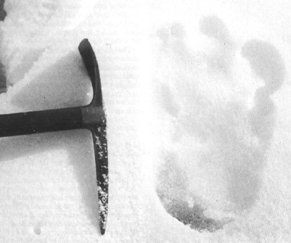
The Alma and Yeti: Wildmen of Asia
________________________________________________________________________________________________________________________
| In the forests and plains of
Siberia and China and in the mountains of the Himalayas, live
two races of mysterious hairy wild people. Called "Alma" by the Chinese and Soviets and "Yeti" by the Nepalese and Tibetans, these
creatures average five feet in height and are covered from
head to toe by a coarse hair -- silver and white in the
mountainous regions, and orange and brown in the forests.
These creatures are seen only at random, and the evidence for their existence is mostly hair samples, footprints, and vague sightings. Scientists believe the Alma and Yeti are surviving ancestors of our own species; but until specimens are caught, living or dead, final proof is missing. |
| There is much disagreement on
both what the word 'Yeti' means, and where the name
'Abominable Snowman' -- the common Western and European name
for the beasts -- came from (there doesn't appear to be any
explanation of the word 'Alma' yet). According to Sir Edmund Hillary in his article in the 1961 World Book Encyclopedia 'Yeti' is believed to have originally meant "all-devouring creature"; however, according to Jenny Randles in her book: Strange & Unexplained Mysteries of the 20th Century, the word is from the Sherpa Yeh-teh meaning 'rock thing.' As for the title 'Abominable Snowman', in Stranger Than Science, Frank Edwards asserts that it is said to either be from a translation of the word 'Yeti', or a translation of the Tibetan name for the creatures, metoh kangmi; but the authors of the Webster's Third New International Dictionary feel the phrase is a mistranslation of the Tibetan 'mi-te', or 'man-bear'. While Jenny Randles states that it comes from a mistranslation of a Tibetan phrase that actually translates as 'manlike creature that is not a man.' As for the legend itself, there is only little variation. The Yeti is said to have a horrible scent and white or gray hair, though most other sources describe these creatures as having dark hair. |
________________________________________________________________________________
 A
psychological belay to base camp.
A
psychological belay to base camp.